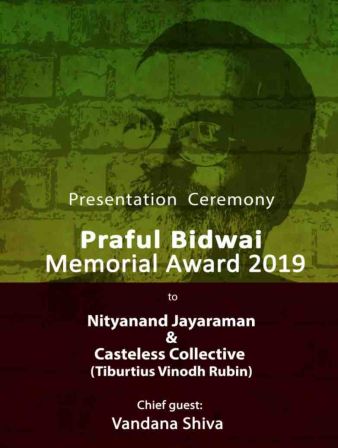
 Praful Bidwai Memorial Award 2019 ceremony on 27 July - 6 pm on. Venue: Deputy Speaker Hall, Constitution Club, Rafi Marg, New Delhi
Announced: Praful Bidwai Memorial Award 2019 ceremony on 27 July in New Delhi
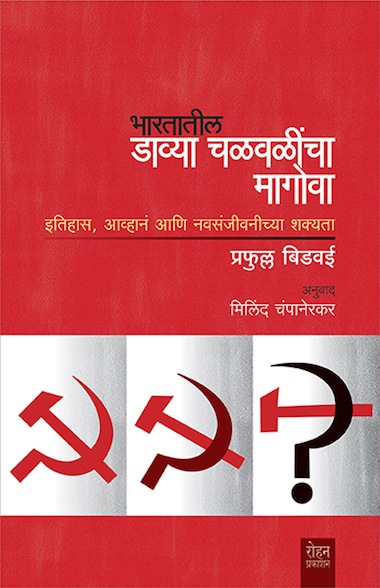
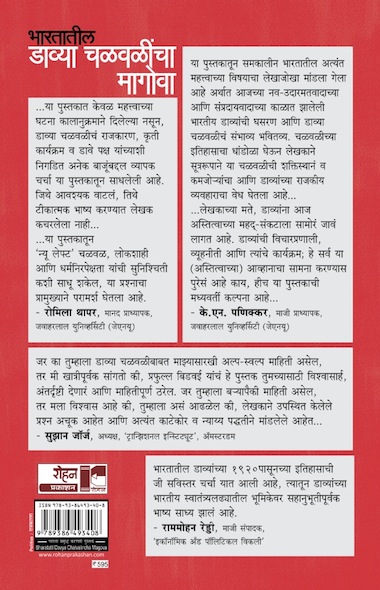
Announced: 'Bharatateel Davya Chalvalincha Magova' Marathi translation of Praful Bidwai's book Phoenix Moment - Book launch & symposium on 5 Oct 2018 in Pune
INVITATION
Late Praful Bidwai’s book ‘THE PHOENIX MOMENT, Challenges Confronting the Indian Left’ was published in 2015. Now it’s MARATHI version published by ROHAN Prakashan, Pune, ‘Bharatateel DAVYA CHALVALINCHA MAGOVA – Itihas, Avhaane aani Nav-Sanjivaneechya Shakyata’ (translated by Milind Champanerkar ) will be released on Friday, 5 th October, 2018 at Shramik Patrakar Sangh Hall, Navi Peth, Pune. The Release function includes a Symposium on ‘Davee Chalval: Nav-Sanjivaneechya Shakyata’. This programme has been jointly organised by ‘ROHAN PRAKASHAN, Parivartanacha WATSARU and SAMAJ VIDNYAN AKADEMI, Pune.
The programme will be as follows:
Book Release & Symposium Time: Friday, 5 th October, 2018, Evening 5.30 pm to 8.30 pm Venue: Shramik Patrakar Sangh Hall, Navi Peth, Pune
Book Release Compeering/Welcome: Milind Champanerkar Publisher’s Speech: Pradeep Champanerkar Book Release: in presence of Kumar Ketkar, Achin Vanaik and Gopal Guru Speakers: Surendra Jondhale Achin Vanaik Kumar Ketkar
Symposium: Bharatateel Davee Chalval: Nav-sanjivaneechya Shakayata Introduction: Suhas Paranjape Participants: Kumar Shiralkar Ulka Mahajan Sandhya Gokhale Jayant Pawar
Concluding Speech Gopal Guru (Editor, EPW)
- Rohan Prakashan *Parivartanacha Watsaru *Samaj Vidnyaan Akademi
Milind Champanerkar/ Pradeep Champanerkar/ Abhay Kanta/ Surendra Jondhale/Suhas Paranjape/ Swatija / Datta Desai / Anant Phadake
A quick take on the 2018 Praful Bidwai Memorial award ceremony held in Delhi
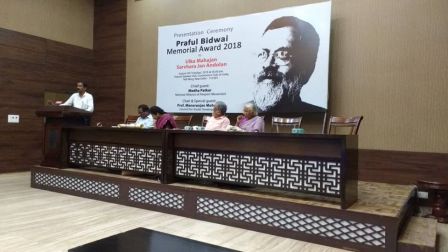
On the 28th August evening, even as arrests of human rights defenders were happening all over the country, the Praful Bidwai Memorial award ceremony took place. The award went to Ulka Mahajan of the Sarvahara Jan Andolan of Raigad who spoke movingly about her three decades of activism that spanned a broad spectrum from tribal rights to forest lands to empowering local communities to resist corporate attempts to take over of common property resources. Medha Patkar, who was chief guest, spoke movingly about the present political repression and the dire environment scenario in the country with the Kerala flooding on the one hand and the continued building of dams in states across the country on the other. Praful Bidwai would have written trenchantly on all these issues but commentators like him are today few and far between. Manoranjan Mohanty anchored the evening's programme.
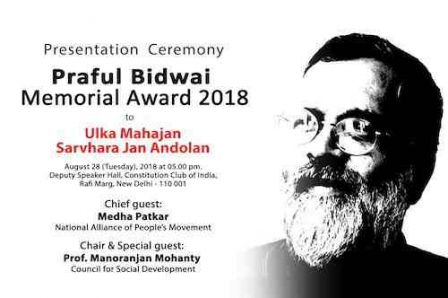
Presentation Ceremony Praful Bidwai Memorial Award 2018 (August 28, 2018 New Delhi)
Presentation Ceremony
Praful Bidwai Memorial Award 2018
to
Ulka Mahajan
Sarvhara Jan Andolan
August 28 (Tuesday), 2018 at 05.00 pm
Deputy Speaker’s Hall, Constitution Club of India
Rafi Marg, New Delhi - 110001
Chief Guest Medha Patker National Alliance of People's Movement
Chair & Special Guest Prof. Manoranjan Mohanty Council for Social Development
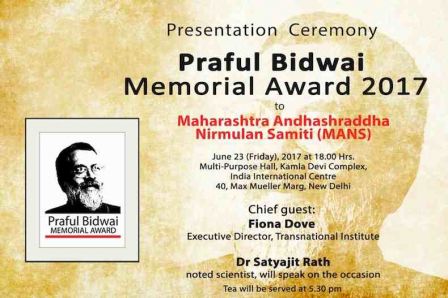
Maharashtra-based Andhashradha Nirmulan Samiti (MANS, Maharashtra Blind Faith Eradication Committee) gets the Praful Bidwai Memorial Award for 2017
Set up in 1989 by Narendra Dhabolkar, a medical doctor who was a rationalist and committed public intellectual, MANS has over the years involved itself in multiple social interventions, from battling superstition and caste to engaging with young students. The organisation’s prime focus has been to challenge blind faith and superstition and disseminate ideas of rationalism and secularism.
Remembering Praful Bidwai ....
There are few journalists who are consistent in what they write, back it with scholarly knowledge, and say it as it is, not as it should be to please bosses or the powers that be. Praful Bidwai was one of this rare species, a journalist who never gave up his freedom to speak out even when at times he was facing penury, and actually felt the pressure of joblessness and a column that the big guys in the newspaper ‘business’ were too terrified to print.
Call for nominations - Praful Bidwai Memorial Award, 2017
This Award seeks to keep alive the legacy of the late Praful Bidwai, noted journalist and social commentator and activist. It carries a cash prize of Rs 1 lakh and is awarded at a special ceremony in New Delhi.
Video recordings from 1st Praful Bidwai Memorial Award Ceremony (23 June 2016)
Interventions by Professor Romila Thapar and P. Sainath at the Praful Bidwai memorial award on June 23, 2016, Deputy Speaker Hall, Constitution Club, Rafi Marg, New Delhi
First Praful Bidwai Memorial Award Goes to People’s Archive of Rural India (PARI)
New Delhi, June 23: The first Praful Bidwai Memorial Award has gone to the People’s Archive of Rural India (PARI), which was set up in 2014 by noted Mumbai-based journalist and commentator, Palagummi Sainath.
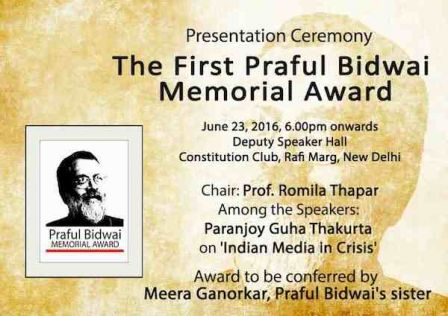
The First Praful Bidwai Memorial Award ceremony is planned for June 23, 2016
New Delhi, June 8: The Praful Bidwai Memorial Award has been set up to commemorate the life and work of one of India’s most outstanding journalists as well as accomplished author, committed activist and public intellectual, so that his legacy would inspire others.
Announcing the imminent arrival of a compilation of articles by Praful Bidwai on Nuclear Matters
A collection of articles written by Praful Bidwai between the early 1980s upto 2014 on military and civil nuclear matters is being published in a book form by Coalition for Nuclear Disarmament and Peace (CNDP) and will be available very soon.
here is the book cover

Sumanta Banerjee's review of The Phoenix Moment in Economic and Political Weekly
Praful left us on 23 June 2015. But we are thankful to him for leaving behind for us this wonderful intellectually stimulating book that traces not only the history of the Indian communist movement, but also suggests an alternative courageous strategy for the left in the coming future.
Can the Indian Left seize its Phoenix Moment? - A book review by G. Sampath
Divided into eight chapters and spanning 500-odd pages buttressed by voluminous endnotes The Phoenix Moment begins with the founding of the Communist Party of India in 1925 . . . Now, after almost a century of training itself not to think, and not to venture beyond narrow Parliamentary politics, can the Left undertake a bold and honest introspection with a potential for radical course correction?
Reinventing The Indian Left: A Review Of 'The Phoenix Moment: Challenges Confronting the Indian Left’ By Praful Bidwai (Satya Sagar) | countercurrents.org, 28 Feb 2016
‘The Phoenix Moment: Challenges Confronting the Indian Left’, written by the well-known journalist Praful Bidwai, is a fascinatingly detailed study of why the Indian Left both rose to dizzying heights in the past and crashed ignominiously in recent times. The last book he wrote before his untimely demise last year, it is brutally honest, meticulously researched and bitingly critical. It is also impressively broad in scope, analyzing the Left from not just the usual parameters of redistribution of wealth, public welfare and workers’ rights but also ecology, gender and caste.
Book Review: Is Left finally moving to the centre? (Shikha Mukerjee) | Asian Age, 28 Feb 2016
When business is as usual, the dilemma of the Communist Party of India (Marxist) and, by extension, of the parliamentary political parties that can broadly be categorised as the Left is to find a comprehensive resolution that captures the theory as well as the practice of doing the impossible — finding a way of straddling electoral politics with its continuous compromises and the ideology of an emancipating revolution.
Book review: The Last Word (Tanika Sarkar) | The Indian Express, 16 January 2016
The first half covers colonial and immediate post-colonial times, and the second explores Kerala and West Bengal, both ruled by the Left for long stretches of time.
Book Review: So, What is Left? (Zia Haq) | Hindustan Times, 2 Jan 2016
Praful Bidwai’s posthumous book is a rich intellectual history of the Left, its contemporary fate and how it can fight back a neoliberal onslaught
Remembering Praful Bidwai on Human Rights Day - Video recording from a public discussion on 10 Dec 2015 in Bangalore
Video of Human Rights Day-Praful Bidwai book release and discussion in Bangalore at Aruppe Hall at St Joseph's college on 10 December 2015. The meeting was chaired by Cynthia Stephen and the panelists were Professor Lawrence Surendra, Dept of Economics, University of Mysore, Professor Sowmya Uma, Centre for the Study of Social Exclusion and Inclusive Policy, National Law School of India University, Professor Suvrat Raju, Tata Instt of Fundamental Research, Communist Party of India (Marxist) leader G.N. Nagaraj.
« previous entries - page 1 of 17